What is Firewall Security?
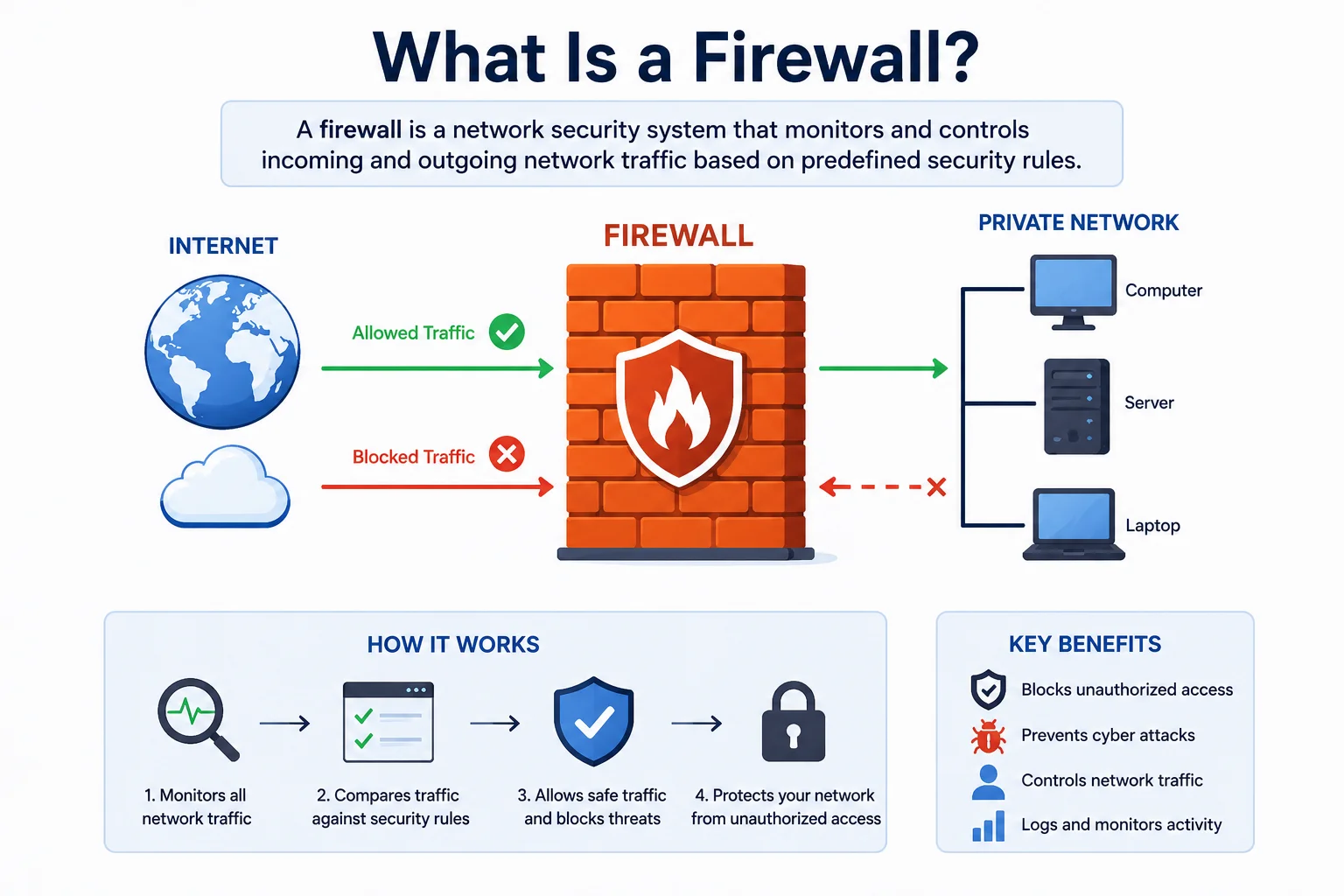
A firewall is a network security device or software that monitors incoming and outgoing network traffic based on predefined security rules. It creates a protective barrier between trusted internal networks and untrusted external networks, such as the internet.
Every piece of data entering or leaving your organization's network passes through the firewall. It analyzes each connection request and determines whether it should be allowed or blocked based on security policies.
Without a firewall, hackers could exploit vulnerabilities, install malware, steal sensitive information, or gain unauthorized access to business systems.
Think of a firewall as the security guard at the entrance to your office. Every visitor is checked before being allowed inside. Similarly, every data packet is inspected before entering your network.
Why Firewall Security is Essential in 2026
Cybercriminals are becoming increasingly sophisticated, using artificial intelligence, automated attack tools, and advanced malware to target businesses. At the same time, organizations rely more heavily on cloud services, remote employees, mobile devices, and connected technologies.
This evolving landscape has expanded the attack surface, making traditional security methods insufficient.
Modern firewalls help organizations:
- Prevent unauthorized access
- Detect suspicious network behavior
- Block malware and ransomware
- Secure remote workers
- Protect cloud environments
- Control application usage
- Improve compliance with security standards
- Monitor network activity in real time
Firewall security is no longer just about blocking unwanted traffic. It has become an intelligent cybersecurity platform capable of identifying and responding to modern threats.
How Does a Firewall Work?
A firewall continuously monitors network traffic entering and leaving your business.
When a user accesses a website, connects remotely, downloads a file, or uses a cloud application, the firewall examines the traffic using several criteria, including:
- Source IP address
- Destination IP address
- Network ports
- Communication protocols
- Application type
- User identity
- Device information
- Threat intelligence databases
If the traffic complies with the organization's security policies, it is allowed to pass. If it appears malicious or unauthorized, the firewall blocks the connection before it reaches internal systems.
Many modern firewalls also inspect encrypted HTTPS traffic to detect hidden malware that older security systems might miss.
Types of Business Firewalls
1. Packet Filtering Firewall
Packet filtering firewalls inspect basic information such as IP addresses, ports, and protocols.
Advantages
- Fast performance
- Low resource usage
- Simple deployment
Limitations
- Limited visibility into application traffic
- Cannot detect sophisticated attacks
2. Stateful Inspection Firewall
Stateful firewalls monitor active network sessions instead of examining individual packets independently.
This allows them to distinguish legitimate communication from suspicious traffic more accurately.
Benefits
- Better protection than packet filtering
- Session-aware inspection
- Widely used in business environments
3. Proxy Firewall
A proxy firewall acts as an intermediary between users and the internet.
Instead of allowing direct communication, it receives requests on behalf of users and forwards approved traffic.
Benefits
- Hides internal network information
- Additional security layer
- Content filtering capabilities
4. Next-Generation Firewall (NGFW)
The Next-Generation Firewall has become the preferred choice for modern businesses.
NGFW combines traditional firewall functions with advanced cybersecurity technologies.
Features include:
- Deep Packet Inspection (DPI)
- Intrusion Prevention System (IPS)
- Application awareness
- SSL inspection
- Malware detection
- URL filtering
- User identity management
- VPN services
- Threat intelligence integration
For most organizations in 2026, an NGFW provides the best balance between performance, security, and scalability.
5. Cloud Firewall (Firewall as a Service)
Cloud firewalls are specifically designed to protect cloud infrastructure, SaaS platforms, and remote workforces.
Instead of relying solely on on-premises hardware, organizations can manage firewall policies centrally while securing users regardless of location.
Cloud firewalls are particularly useful for businesses using Microsoft 365, Google Workspace, AWS, Azure, and hybrid cloud environments.
Key Features to Look for in a Business Firewall
When selecting a firewall solution, businesses should prioritize the following capabilities:
- Deep Packet Inspection
- Intrusion Prevention System (IPS)
- Application Control
- SSL/TLS Inspection
- Web Filtering
- DNS Security
- VPN Support
- Multi-Factor Authentication Integration
- Zero Trust Compatibility
- AI-powered Threat Detection
- Threat Intelligence Updates
- Centralized Management
- High Availability
- Detailed Reporting
- Security Analytics Dashboard
These features help organizations stay ahead of evolving cyber threats while maintaining network performance.
Common Cyber Threats Firewalls Can Block
A properly configured firewall protects businesses against numerous cyber threats, including:
- Ransomware attacks
- Malware infections
- Phishing websites
- Spyware
- Botnet communications
- Unauthorized remote access
- Port scanning
- Brute-force login attempts
- Command-and-control traffic
- Data exfiltration attempts
- Network reconnaissance attacks
- Certain Denial-of-Service (DoS) attacks
Although no firewall can eliminate every threat on its own, it significantly reduces the attack surface when combined with endpoint security, email protection, and regular software updates.
Benefits of Firewall Security for Businesses
Protect Sensitive Data
Firewalls prevent unauthorized access to confidential business information, customer records, financial data, and intellectual property.
Reduce Cybersecurity Risks
By blocking malicious traffic before it enters the network, firewalls reduce the likelihood of successful cyberattacks.
Secure Remote Employees
Businesses with hybrid or remote workforces can provide secure VPN access while enforcing consistent security policies across all users.
Improve Compliance
Many industry regulations and cybersecurity frameworks require organizations to implement network security controls, including firewalls.
Better Network Visibility
Administrators gain real-time insight into application usage, internet traffic, bandwidth consumption, and security events.
Network Segmentation
Firewalls can separate departments, guest Wi-Fi, IoT devices, and critical servers into isolated zones, limiting the spread of attacks.
Firewall Best Practices in 2026
To maximize protection, businesses should follow these best practices:
- Keep firewall firmware updated
- Review security rules regularly
- Remove unused firewall policies
- Enable Intrusion Prevention
- Use Multi-Factor Authentication
- Monitor firewall logs daily
- Implement network segmentation
- Restrict unnecessary open ports
- Secure remote access with VPNs
- Perform regular vulnerability assessments
- Test backup and disaster recovery plans
- Integrate firewall management with endpoint protection and SIEM tools
Regular maintenance is just as important as selecting the right firewall.
Signs Your Business Needs a Firewall Upgrade
If your organization experiences any of the following issues, it may be time to upgrade your firewall:
- Increasing malware incidents
- Frequent VPN performance issues
- Growing remote workforce
- Migration to cloud applications
- Unsupported firewall hardware
- Lack of SSL inspection
- Limited application visibility
- Poor reporting capabilities
- Increasing compliance requirements
- Expansion to multiple office locations
Modern cybersecurity threats require modern security solutions.
Choosing the Right Firewall Solution
Every business has unique security requirements.
When evaluating firewall solutions, consider:
- Number of employees
- Internet bandwidth
- Number of branch offices
- Remote workforce requirements
- Cloud adoption
- Business growth plans
- VPN capacity
- Security compliance requirements
- High Availability needs
- Budget and long-term maintenance costs
Rather than focusing solely on hardware specifications, organizations should prioritize security capabilities, scalability, centralized management, and vendor support.
Why Managed Firewall Services Make Sense
Many organizations lack the internal resources to manage firewall security effectively.
Managed Firewall Services provide ongoing monitoring, policy management, software updates, threat detection, and technical support from experienced cybersecurity professionals.
Benefits include:
- 24/7 monitoring
- Faster threat response
- Professional configuration
- Regular firmware updates
- Security policy optimization
- Compliance reporting
- Reduced workload for internal IT teams
This approach allows businesses to focus on operations while maintaining strong network security.
Why Choose ITSP Middle East?
At ITSP Middle East, we help businesses across the UAE build secure, reliable, and future-ready IT infrastructures.
Our cybersecurity specialists design, deploy, and manage enterprise-grade firewall solutions tailored to your organization's needs.
Our firewall services include:
- Firewall consultation
- Next-Generation Firewall deployment
- Firewall migration and upgrades
- VPN configuration
- Firewall policy optimization
- Managed Firewall Services
- Network security assessments
- 24/7 monitoring and technical support
Whether you're protecting a small office or a multi-site enterprise, our team can help you implement a firewall strategy that aligns with your business goals and security requirements.
Conclusion
As cyber threats continue to evolve, firewall security remains one of the most important components of a comprehensive cybersecurity strategy. Modern firewalls do much more than block unwanted traffic—they provide intelligent threat prevention, secure remote access, application visibility, and integration with advanced security technologies.
Businesses that invest in the right firewall solution are better equipped to protect sensitive data, maintain business continuity, meet compliance requirements, and defend against increasingly sophisticated cyberattacks.
If your organization is planning to strengthen its cybersecurity posture in 2026, now is the perfect time to evaluate your firewall infrastructure and ensure it is capable of meeting today's security challenges.
Frequently Asked Questions (FAQs)
What is the primary purpose of a firewall?
A firewall protects business networks by monitoring and filtering incoming and outgoing traffic, blocking unauthorized access while allowing legitimate communications.
Do small businesses need a firewall?
Yes. Small businesses are frequently targeted by cybercriminals because they often have fewer security resources. A firewall provides essential protection regardless of company size.
What is the difference between a traditional firewall and a Next-Generation Firewall?
Traditional firewalls mainly filter traffic based on IP addresses and ports, while Next-Generation Firewalls include advanced features such as intrusion prevention, application control, malware detection, SSL inspection, and threat intelligence.
Can a firewall prevent ransomware?
A firewall can block many ransomware delivery methods and detect suspicious network activity. However, it should be used alongside endpoint protection, email security, regular updates, and reliable backups as part of a layered security strategy.
How often should firewall rules be reviewed?
Firewall rules should be reviewed regularly, especially after infrastructure changes, new application deployments, or security incidents. Many organizations perform quarterly reviews along with continuous monitoring to ensure policies remain effective and up to date.