What Is a Traditional WAN?
A wide area network connects offices, branches, data centres, and other locations across geographical distances.
“Traditional WAN” describes a broad category of network designs. These may use MPLS services, leased circuits, or conventional site-to-site VPN connections. MPLS is a common example, but it does not represent every traditional WAN.
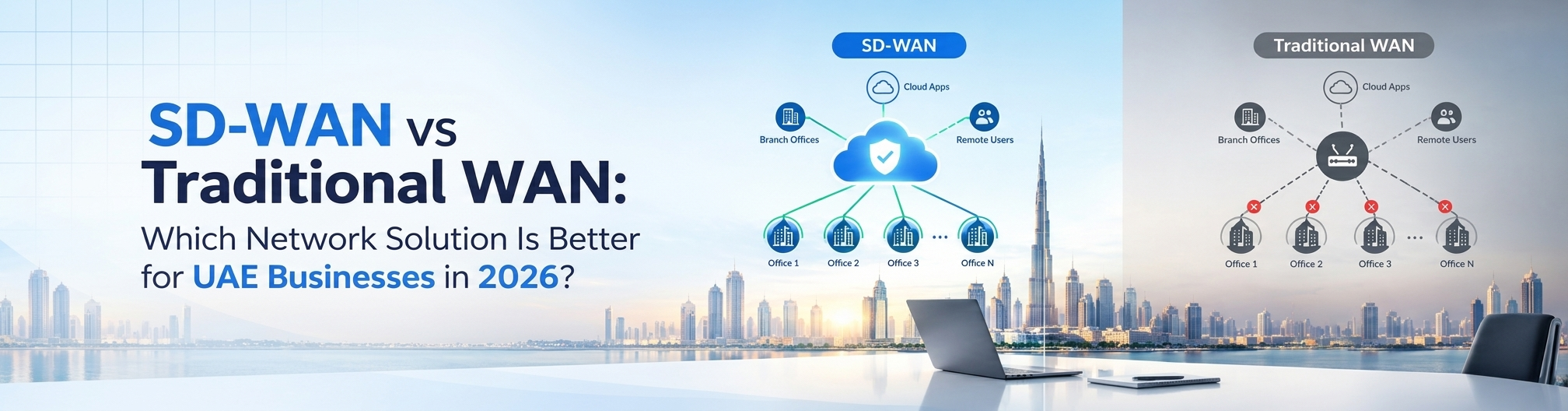
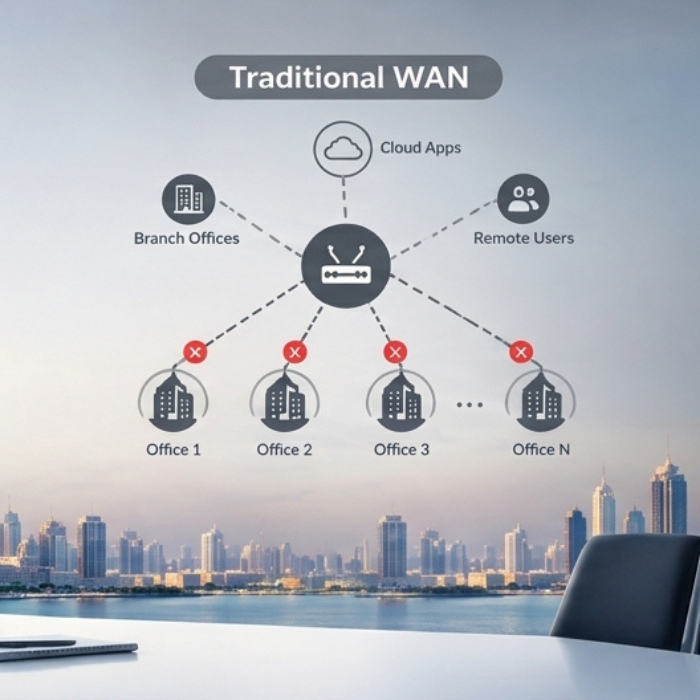
In a familiar branch network design, employees connect to applications through a central office or data centre. Internet traffic may also pass through that central location, where security controls are applied.
Cisco describes this centralised traffic pattern as common in legacy WAN architectures. It can create challenges when growing volumes of cloud application traffic must pass through the central site.
However, an existing WAN may continue to serve a business well. Its suitability depends on how it was designed, the services supporting it, and whether current applications still match the original requirements.
What Is SD-WAN?
SD-WAN stands for Software-Defined Wide Area Network.
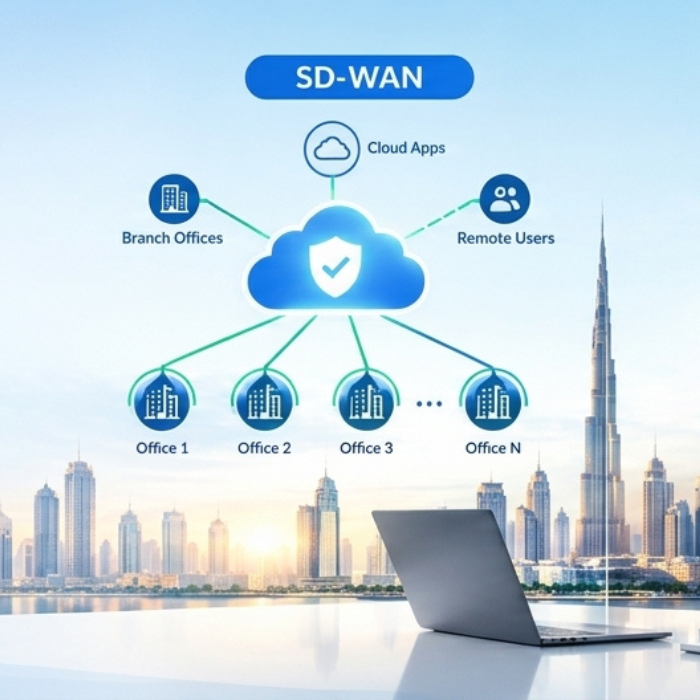
It uses software-based policies to manage traffic across available connections. These connections can include broadband internet, MPLS, cellular services, and other supported network transports.
A key distinction is that SD-WAN can run over MPLS. They are not mutually exclusive technologies. MPLS provides connectivity, while SD-WAN adds an overlay that controls how traffic uses the underlying connections.
Cisco describes its SD-WAN architecture as an encrypted overlay spanning transports such as MPLS, broadband, cellular, and cloud connectivity.
For example, a branch could have a private circuit and a business internet connection. SD-WAN policies can determine which applications use each path and how traffic should respond when conditions change.
The exact capabilities depend on the platform, licences, configuration, and underlying services.
SD-WAN vs Traditional WAN: Key Differences
The following comparison describes common deployment patterns. Individual networks may differ.
| Factor | Traditional WAN approach | SD-WAN approach |
|---|
| Architecture | Often organised around central sites and established routing designs | Uses an overlay with centrally defined traffic policies |
| Connectivity | May use MPLS, leased circuits, or internet VPNs | Can combine MPLS, internet, cellular, and other supported transports |
| Application handling | Depends on routing and quality-of-service configuration | Can select paths based on application policies and measured link conditions |
| Cloud access | May route through headquarters or use separately designed internet access | Can support controlled local internet access at branches |
| Management | Varies from individual device administration to centrally managed services | Typically provides central policy management and visibility |
| Resilience | Depends on redundant links, equipment, and routing design | Can steer traffic across available alternative paths |
| Security | Requires appropriate encryption, firewalls, access controls, and monitoring | Requires the same security planning; integration varies by product |
| Costs | Depend on circuits, equipment, support, and contracts | Add platform costs while potentially changing connectivity and operational costs |
Cisco’s design guidance describes central management, mixed transports, application policies, and direct internet access as core SD-WAN capabilities.
1. Application Performance: Which Approach Works Better?
Employees experience network quality through applications. A connection that looks fast on paper may still deliver poor results during video meetings, file transfers, or access to business systems.
Three useful measurements are:
Latency: How long data takes to reach its destination.
Jitter: How much that delay varies.
Packet loss: How much transmitted data fails to arrive.
SD-WAN platforms can use these measurements to select suitable paths for particular applications. Cisco’s application-aware routing guidance describes policies that evaluate loss, latency, and jitter against defined performance requirements.
Consider a business with two connections at each branch. If one connection becomes unsuitable for a real-time application, an appropriate policy may direct that application over the alternative connection.
However, SD-WAN cannot create bandwidth that does not exist or guarantee good performance when every available path is poor.
For a UAE business evaluating proposals, the useful question is: How will the proposed network improve the applications our employees actually use?
Ask for a demonstration using realistic workloads, rather than relying only on headline connection speeds.
2. Cloud Access: A Strong Reason to Review the Network
Businesses using Microsoft 365, cloud accounting, hosted CRM systems, and online collaboration platforms should examine how traffic reaches those services.
Sending every branch’s internet traffic through headquarters may create an unnecessary dependency on the central site. Depending on the network, it can also introduce additional delay.
SD-WAN can support direct internet access at branches, with suitable security controls applied locally or through a cloud security service. Cisco identifies this as a way to address the limitations of centralised internet traffic routing.
For example, a Dubai head office and an Abu Dhabi branch may both depend heavily on cloud applications. A network assessment should determine whether routing the branch’s traffic through Dubai delivers a useful security or operational benefit.
Local internet access is not automatically the right answer for every application. The design should reflect security requirements, application destinations, and the quality of available connections.
3. Reliability: Evaluate the Entire Design
Reliable connectivity requires more than a particular technology label.
Traditional networks can have redundant circuits, backup equipment, and automatic routing recovery. SD-WAN can also use multiple connections and respond to deteriorating link conditions.
The important difference is how effectively the proposed design detects problems and maintains the applications your business needs.
For example, two connections may appear independent while sharing a physical route, building entry point, or other infrastructure. A single incident could affect both.
A useful resilience assessment should consider:
Whether links have genuinely different failure risks.
Whether the backup connection can carry essential traffic.
Whether edge equipment and power supplies introduce single points of failure.
How applications behave when traffic changes paths.
Who receives alerts and takes responsibility for recovery.
Avoid assuming that automatic failover means every active session will continue without interruption. Results depend on the platform, addressing, application behaviour, and configuration.
For a retail branch, an acceptance test should include its actual payment and order workflows. For an office, it should include the business applications employees cannot work without.
4. Security: Neither Option Removes the Need for Protection
A private network and an encrypted network are different things.
MPLS can provide traffic separation within a provider network, but MPLS does not inherently encrypt business traffic. Encryption and other controls must be addressed in the wider design.
SD-WAN solutions commonly support encrypted connections and may integrate firewalls or other security capabilities. The extent of that protection varies between products and subscriptions.
Fortinet, for example, describes its Secure SD-WAN offering as combining networking and security within a shared operating and management environment. That is a product capability, rather than a guarantee that every SD-WAN solution includes equivalent protection.
When reviewing a proposal, ask which security functions are included, which require additional licences, and who manages them.
For many businesses, separating guest Wi-Fi, employee devices, and operational systems is also an important design consideration.
Security should be evaluated through specific controls and responsibilities—not simply whether the proposal uses “private,” “secure,” or “SD-WAN” in its description.
5. Costs: Compare the Full Business Case
SD-WAN is often associated with lower connectivity costs because it can use broadband alongside or instead of some private circuits.
However, savings are not automatic.
A company may reduce one cost while adding subscriptions, security services, managed support, or additional connections. An existing contract may also affect the economics of changing services.
A useful comparison includes:
| Cost category | What to include |
|---|
| Connectivity | Primary links, backup links, installation, and usage charges |
| Hardware | Branch appliances, redundancy, replacements, and support |
| Software | SD-WAN subscriptions and required feature licences |
| Security | Included controls and separately purchased services |
| Implementation | Assessment, migration, configuration, and acceptance testing |
| Operations | Monitoring, support, administration, and staff training |
| Contract transition | Notice periods, overlapping services, and applicable exit costs |
Compare proposals over the same period and at the same service level.
For UAE businesses, request site-specific quotations in AED, with VAT treatment clearly stated. Confirm what is included at each address instead of assuming the same package is available everywhere.
The better financial decision is the one that meets operational needs at an acceptable total cost.
6. Management: Centralisation Can Help Growing Businesses
Managing several branches becomes difficult when each location has different configurations and undocumented exceptions.
SD-WAN’s central policy approach can help standardise how branches are configured and monitored. Cisco describes centralised provisioning, monitoring, and troubleshooting as benefits of the architecture.
This can be useful for a company opening new offices or standardising existing sites.
For example, a business could define a consistent policy for employee traffic, guest access, and critical applications, then adapt it to the needs of each location.
However, centralisation also makes change control important. An incorrect policy applied widely can affect several sites.
The operating model should therefore include configuration review, controlled rollout, access restrictions, and a clear recovery process.
UAE Connectivity and Managed Service Considerations
UAE businesses can explore managed SD-WAN offerings from providers including e& and du. Their official websites list SD-WAN services, with e& also describing a managed offering.
The presence of a service offering does not establish availability, price, or suitability for a particular building.
Before committing, confirm:
Connectivity availability and installation times at each site.
The platform and features included in the proposal.
Responsibility for circuits, equipment, security policies, and monitoring.
Support hours, escalation routes, and replacement arrangements.
Service-level commitments and exclusions.
Access to reports and configuration information.
Ownership and transition arrangements when the contract ends.
For organisations with limited internal networking expertise, a managed service may be practical. Businesses with an experienced network team may prefer greater direct control.
Neither model removes the need for an accountable person inside the business to review performance and approve significant changes.
Which Solution Fits Different Business Situations?
The following are illustrative scenarios.
A Business With Several Cloud-Dependent Branches
A company with offices across Dubai, Sharjah, and Abu Dhabi may benefit from evaluating SD-WAN if cloud access, central visibility, and consistent policies are priorities.
A pilot should establish whether the proposed connections and policies improve the employee experience.
A Business With Important Applications in Its Own Data Centre
An organisation with stable private connectivity and sensitive application performance requirements may choose to retain MPLS.
Adding SD-WAN over that connectivity can be considered where central management, additional paths, or cloud access would provide measurable value.
A Small Company Operating From One Office
A full SD-WAN deployment may offer limited value if the business has straightforward requirements.
A suitable business connection, properly configured firewall, and backup link may be sufficient. The assessment should establish a clear need before introducing additional platform costs.
A Company Opening Temporary or New Locations
SD-WAN can use supported cellular connectivity, which may be useful when fixed services are not yet available.
Actual suitability depends on coverage, capacity, service terms, and application requirements. Cellular access should be tested at the location where it will operate.
How to Evaluate a Migration
Start by documenting the current network and the business problems you want to solve.
Record the applications used at each location, existing connection performance, contract commitments, and recurring incidents. Establish which workloads are most important during an outage.
Next, define measurable acceptance criteria. These could include application response times, recovery behaviour, reporting visibility, and support escalation.
Pilot the proposed design at a representative branch. Test normal operations, congestion, link failure, and recovery. Include the employees who use the applications every day.
Review the results before expanding the deployment. Keep a practical rollback plan and avoid retiring working connections until the replacement has demonstrated acceptable performance.
This approach creates evidence for the decision and helps identify configuration problems before they affect the whole business.
Frequently Asked Questions
Does SD-WAN replace MPLS?
It can reduce or remove the need for MPLS in some designs, but it can also run over MPLS. The right combination depends on application needs and available services.
Will SD-WAN make our internet faster?
It can improve how applications use available paths. It does not increase the purchased capacity of an individual connection or solve every source of application delay.
Is SD-WAN always cheaper?
No. Compare connectivity, subscriptions, equipment, security, support, and migration costs before deciding.
Does SD-WAN guarantee uninterrupted operations?
No. Availability depends on the complete design, including connections, equipment, power, applications, and operational support.
Can an SME benefit from SD-WAN?
Yes, particularly where multiple sites, cloud applications, and central management create a clear need. A smaller, simpler business may be adequately served by a less complex network.
Choosing the Right Network for Your UAE Business
For UAE businesses reviewing their networks in 2026, SD-WAN is a strong option where application flexibility, multiple connections, and central management are priorities.
Traditional WAN services can remain valuable where existing connectivity performs well or private transport meets a specific requirement. A hybrid design may provide the most practical balance.
The decision should follow an assessment of your applications, sites, service commitments, and total costs. A well-designed network should make everyday work more reliable and remain manageable as the business changes.
Planning a network upgrade? Contact ITSP Technologies Co. LLC to discuss your business requirements and the next steps in evaluating your WAN options.