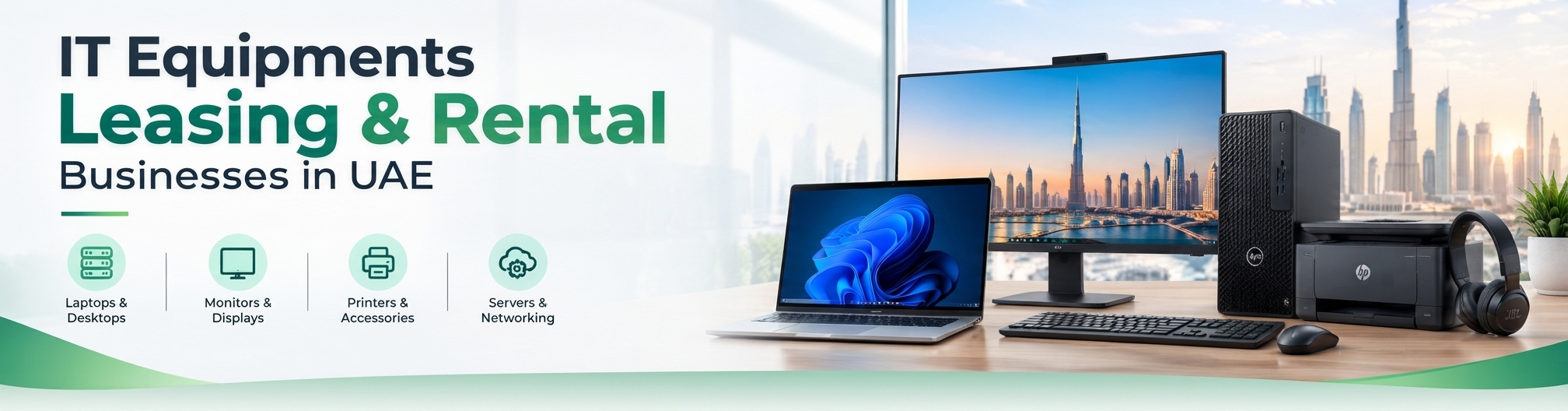
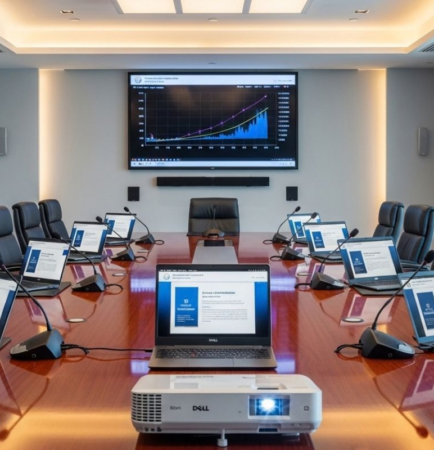
What Is IT Equipment Leasing and Rental?
IT equipment leasing and rental are arrangements where a business obtains the use of technology for an agreed period instead of purchasing the equipment outright.
Although the terms are often used interchangeably, they can represent different commercial models.
IT Equipment Rental
Rental is generally suitable when equipment is required for a shorter or clearly defined period.
Examples include:
- Corporate events
- Exhibitions and trade shows
- Training sessions
- Temporary offices
- Short-term projects
- Seasonal operations
- Employee onboarding
- Conferences and seminars
- Testing and evaluation
- Emergency replacement requirements
Rental periods can vary depending on the provider and requirement, including daily, weekly, monthly, or project-based arrangements. UAE rental providers currently advertise both short- and long-term options across laptops, printers, networking equipment, servers, tablets, and event technology.
IT Equipment Leasing
Leasing is generally more appropriate when a business requires equipment for a longer period.
Instead of purchasing a fleet of devices immediately, a company can arrange a lease over an agreed contract term and make scheduled payments.
For example, businesses may lease:
- Employee laptops
- Desktop computers
- Workstations
- Servers
- Networking equipment
- Printers and multifunction devices
- Tablets
- Telephony equipment
- POS equipment
- Office technology
Some UAE leasing providers structure technology acquisition around longer refresh cycles, while operating-lease models can spread equipment costs across the contract period.
Why Are UAE Businesses Considering IT Equipment Rental?
The technology requirements of a business can change quickly.
A company may hire 20 employees this quarter, open another office next year, or require 50 additional laptops for a temporary project. Purchasing equipment for every short-term requirement can create unnecessary capital expenditure and leave the company responsible for equipment that may no longer be required after the project ends.
Rental and leasing provide businesses with another procurement option.
1. Lower Initial Capital Requirement
Buying a complete IT infrastructure can require significant upfront expenditure.
A leasing or rental arrangement can distribute payments over an agreed period instead of requiring the company to purchase every device immediately.
This can be particularly relevant for:
- Startups
- SMEs
- New offices
- Expanding companies
- Project-based businesses
- Temporary operations
Some UAE technology leasing providers specifically position leasing as an alternative to large upfront capital expenditure.
2. Easier Business Expansion
Technology requirements often increase when a company expands.
For example, a business with 30 employees may suddenly need 20 additional laptops because of recruitment or a new project.
With a flexible rental or leasing arrangement, the company may be able to add equipment without completely redesigning its procurement strategy.
This makes technology procurement more adaptable to changing workforce requirements.
3. Technology Refresh
IT hardware becomes outdated over time.
Instead of continuing to use ageing devices indefinitely, businesses can structure leasing or subscription arrangements around refresh cycles.
Some UAE device-subscription models advertise 24- or 36-month refresh intervals, allowing organisations to periodically replace equipment with newer technology.
4. Suitable for Temporary Projects
Not every IT requirement is permanent.
Consider a company participating in a major exhibition in Dubai. It may require:
- 30 laptops
- 10 tablets
- Printers
- Barcode scanners
- Wi-Fi equipment
- Displays
- Registration systems
Purchasing all of this equipment for a three-day or one-week event may not make operational sense.
IT rental allows the business to obtain the required equipment for the project and return it afterward.
5. Faster Deployment
Some rental providers maintain ready-to-deploy equipment and offer delivery, configuration, installation, and technical support.
For businesses operating under tight deadlines, this can reduce the time between identifying an IT requirement and deploying the equipment.
For example, UAE rental providers advertise delivery and setup services for business and event requirements.
What IT Equipment Can Businesses Rent or Lease in the UAE?
The available equipment depends on the provider, but the UAE market supports a broad range of business technology.
1. Business Laptops
Laptop rental and leasing are among the most common requirements.
Businesses can obtain laptops for:
- Employees
- Temporary staff
- Training programmes
- Events
- Sales teams
- Project teams
- Remote workers
- Contractors
- Conferences
Configurations can range from standard business laptops to higher-performance systems for engineering, development, design, and other demanding workloads.
2. Desktop Computers
Desktop systems can be rented or leased for fixed office environments such as:
- Call centres
- Reception desks
- Back-office operations
- Training centres
- Retail environments
- Administrative departments
3. Workstations
Engineering, architecture, 3D design, video production, CAD, simulation, and other workloads can require more powerful hardware.
Workstation rental can provide access to higher-performance systems without requiring a business to purchase an expensive workstation fleet for a temporary project.
4. Servers and Storage
Businesses may also require temporary or longer-term server infrastructure for:
- Applications
- File storage
- Virtualisation
- Testing environments
- Backup
- Data processing
- Project deployments
Some UAE providers specifically offer server and workstation rental or leasing as part of their IT equipment portfolio.
5. Networking Equipment
Networking requirements can include:
- Managed switches
- Routers
- Firewalls
- Wireless access points
- Network controllers
- Network testing equipment
- Temporary Wi-Fi infrastructure
This can be particularly useful for events, temporary offices, new branches, and project sites.
6. Printers and Multifunction Printers
Businesses can also consider printer rental or leasing instead of purchasing printing equipment.
Depending on requirements, solutions can include:
- A4 printers
- A3 printers
- Colour printers
- Monochrome printers
- Multifunction printers
- Photocopiers
- Scanners
- Production printers
Managed printer arrangements may also include maintenance, toner, technical support, and service-level commitments depending on the contract.
7. Tablets and Mobile Devices
Tablets and mobile devices are useful for:
- Event registration
- Retail
- Sales teams
- Surveys
- Visitor management
- Training
- Digital forms
- Field operations
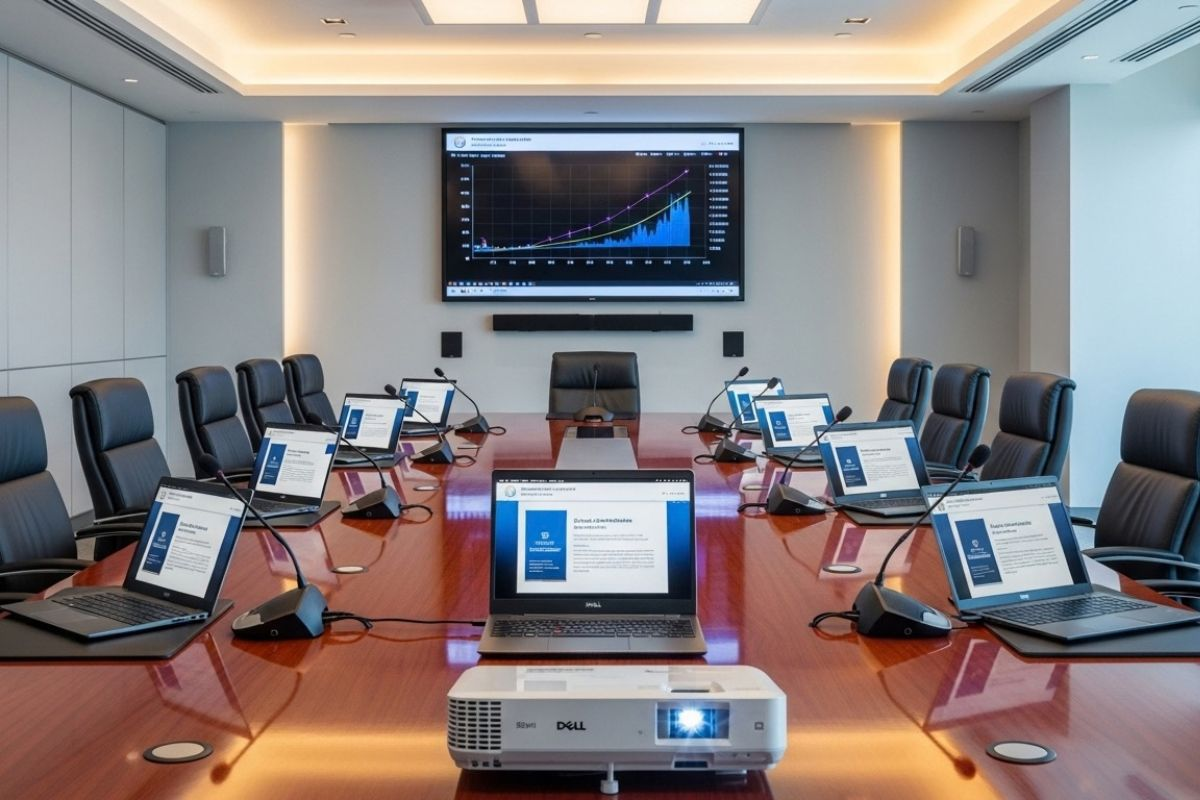
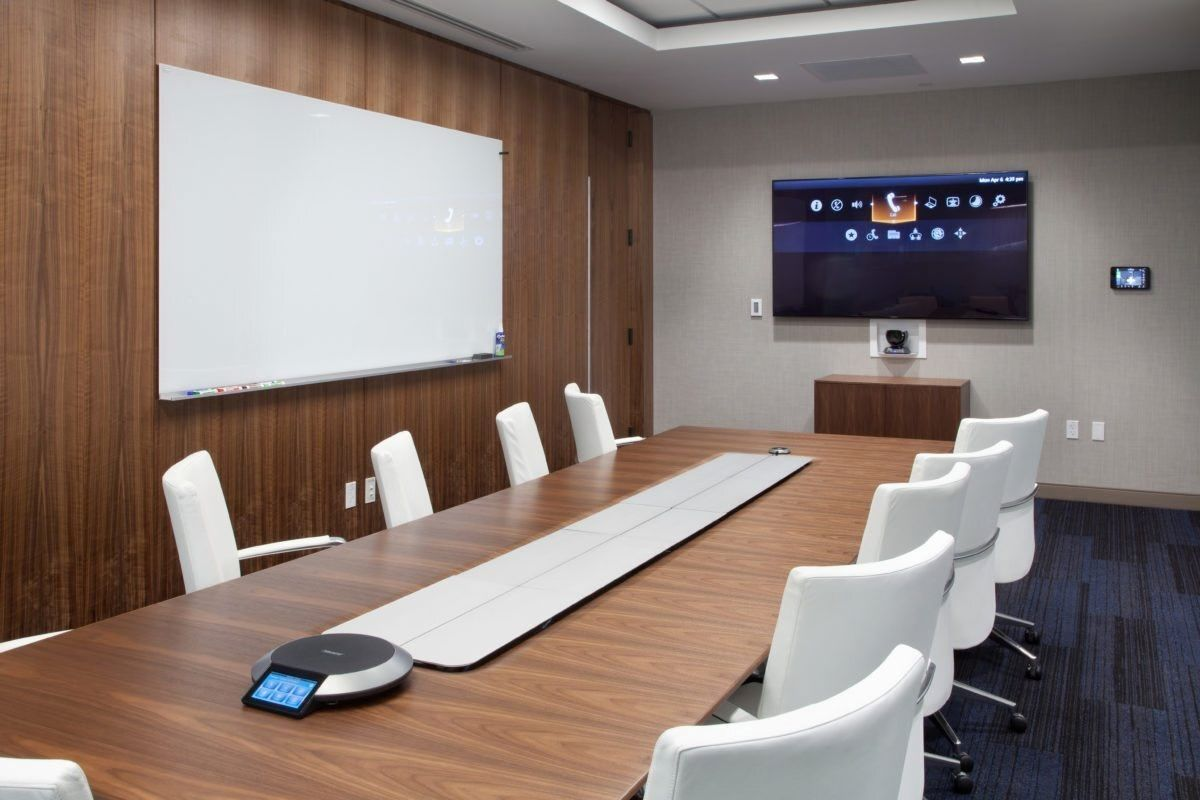
8. Projectors, Displays and AV Equipment
Corporate events and exhibitions frequently require temporary presentation and display technology.
This can include:
- Projectors
- LED displays
- Professional monitors
- Interactive displays
- Touchscreens
- Speakers
- Microphones
- Video conferencing equipment
IT and AV rental companies in Dubai currently provide combinations of computing, display, networking, and event technology for exhibitions, conferences, and corporate activities.
IT Rental vs IT Leasing vs Buying
Choosing between purchasing, renting, and leasing depends on the business requirement.
| Factor | Buying | Renting | Leasing |
|---|
| Initial investment | Higher | Usually lower | Spread over contract |
| Short-term projects | Less suitable | Highly suitable | Depends on contract |
| Long-term use | Suitable | Can become expensive | Suitable |
| Technology refresh | Business-managed | Easy at end of rental | Can be structured into contract |
| Asset ownership | Business owns equipment | Usually no | Depends on agreement |
| Temporary workforce | Requires additional purchases | Flexible | May require longer commitment |
| Events | Often unnecessary | Highly suitable | Usually less suitable |
| Predictable monthly cost | Not always | Possible | Common |
| Equipment return | No | Usually yes | Depends on agreement |
There is no single model that is suitable for every company. The right approach depends on the equipment lifecycle, contract duration, cash-flow requirements, operational requirements, and expected technology refresh cycle.
Who Can Benefit from IT Equipment Rental and Leasing?
IT equipment rental and leasing can support businesses across multiple sectors.
Startups and New Businesses
A startup opening a new office may need laptops, monitors, printers, networking equipment, and other infrastructure immediately.
Leasing or rental can allow the company to establish its technology environment without purchasing every asset at the beginning.
SMEs
Small and medium-sized businesses often need to balance technology investment against other operational expenses.
Flexible IT procurement can help them equip employees while maintaining greater control over cash allocation.
Large Enterprises
Enterprise organisations may use rental and leasing for:
- Employee onboarding
- Temporary projects
- Branch expansion
- Technology refresh
- Disaster recovery
- Events
- Contractor environments
- Testing environments
Events and Exhibitions
Dubai hosts a large number of conferences, exhibitions, corporate events, and business gatherings.
Event organisers may require temporary technology for registration, presentations, demonstrations, networking, and attendee management.
Specialised providers offer equipment such as laptops, printers, scanners, tablets, touchscreens, Wi-Fi equipment, and other event technology.
Training Centres
Training companies may require dozens of computers for a specific course or certification programme.
Instead of maintaining a large permanent hardware inventory, rental can provide equipment when training sessions are scheduled.
Construction and Project-Based Businesses
Temporary project offices can require:
- Laptops
- Printers
- Networking
- Wi-Fi
- Displays
- Workstations
Rental can be considered when the project has a defined lifecycle.
IT Equipment Rental for Events in Dubai
Events require a different approach to IT procurement because the equipment may only be needed for a few days.
A professional event IT setup may include:
Registration
- Laptops
- Tablets
- Barcode scanners
- Badge printers
- Registration software
Networking
- Wi-Fi access points
- Routers
- Network switches
- Temporary internet infrastructure
Presentation
- Projectors
- Displays
- LED screens
- Interactive screens
- Video conferencing equipment
Technical Support
For important events, hardware alone may not be sufficient.
On-site technical support can help address device failures, connectivity issues, configuration problems, and other operational issues during the event.
Some UAE rental providers specifically offer event support and dedicated technical personnel as part of their service.
What Should Businesses Check Before Renting IT Equipment?
Choosing an IT rental provider should involve more than comparing the monthly or daily price.
1. Equipment Specification
Confirm the exact configuration before signing the agreement.
For laptops, check:
- Processor
- RAM
- SSD capacity
- Display size
- Operating system
- Battery condition
- Ports
- Warranty/support
For servers and workstations, check the CPU, memory, storage, GPU, networking interfaces, and operating environment.
2. Equipment Condition
Ask whether the equipment is:
- New
- Refurbished
- Previously rented
- Used
- Open-box
Also clarify how equipment is tested before deployment.
3. Replacement Policy
A failed laptop during an important business project can cause significant disruption.
Ask:
- How quickly will faulty equipment be replaced?
- Is on-site support included?
- Is a spare unit available?
- What happens outside business hours?
Service levels vary significantly between providers, so this should be clearly documented.
4. Delivery and Collection
Confirm whether the quoted price includes:
- Delivery
- Installation
- Configuration
- Collection
- Packaging
- Setup and dismantling
This is particularly important for large deployments and events.
5. Software and Configuration
Hardware may need to be configured with:
- Windows
- Microsoft 365
- Business applications
- Security software
- VPN
- MDM
- Company policies
- User profiles
For corporate deployments, ask the provider whether imaging and configuration services are available.
6. Data Security
Data protection is one of the most important considerations when renting IT equipment.
Before returning devices, businesses should ensure that company data is properly removed.
Depending on the organisation's security requirements, the process may include secure data wiping, device reset, encryption, and documented disposal or sanitisation procedures.
Businesses handling sensitive or regulated information should establish a clear data-handling and device-return process before signing a rental agreement.
Cybersecurity Considerations for Rented IT Equipment
Renting hardware does not remove the organisation's responsibility for cybersecurity.
Every rented laptop or workstation connected to the corporate network should be treated as an enterprise endpoint.
Businesses should consider:
- Endpoint protection
- Strong authentication
- Multi-factor authentication
- Disk encryption
- Secure Wi-Fi
- VPN access
- Patch management
- Least-privilege access
- Device management
- Data backup
- Secure data removal
For temporary workers and contractors, access should also be limited to the systems and information they actually require.
When equipment is returned, the organisation should verify that business data and credentials have been removed according to its internal security policies.
How the IT Equipment Leasing Process Works
A professional leasing process typically begins with a requirement assessment.
Step 1: Identify Your Requirements
Determine:
- Number of users
- Equipment types
- Required specifications
- Deployment location
- Contract duration
- Required software
- Support requirements
Step 2: Select the Procurement Model
Decide whether rental, leasing, subscription, or purchase is most appropriate.
Step 3: Configure the Equipment
The provider prepares the required hardware according to the agreed specification.
Step 4: Delivery and Deployment
Equipment is delivered and, where included, configured at the customer's location.
Step 5: Support and Maintenance
During the contract period, support may cover troubleshooting, maintenance, repair, replacement, or upgrades depending on the agreement.
Step 6: Renewal, Upgrade or Return
At the end of the agreement, businesses may have options such as:
- Returning the equipment
- Extending the agreement
- Upgrading equipment
- Refreshing the fleet
- Purchasing the equipment, if the contract allows it
The exact terms vary by provider and contract.
How to Calculate the Real Cost of IT Rental
Businesses should avoid comparing providers based only on the advertised rental price.
The total cost may include:
Equipment rental + delivery + installation + configuration + support + maintenance + accessories + collection + applicable taxes and contract fees
For example, a laptop rental may appear inexpensive at first, but the final cost can change depending on whether the agreement includes:
- Charger
- Carry case
- Software installation
- Technical support
- Replacement
- Delivery
- Collection
- Damage coverage
A clear quotation should therefore define what is included and what is charged separately.
IT Equipment Leasing for Growing Businesses
Technology procurement becomes more complicated as an organisation grows.
A company with 10 employees may manage devices manually. A company with 100 or 500 employees may need structured processes for:
- Device procurement
- Asset management
- User onboarding
- Security configuration
- Software deployment
- Device replacement
- Repairs
- Retirement
- Data sanitisation
This is where an IT equipment leasing or managed-device strategy can become part of a broader IT lifecycle management programme.
The objective is not simply to obtain cheaper hardware. It is to create a predictable process for acquiring, deploying, maintaining, refreshing, and retiring business technology.
Rental and Leasing for Temporary Offices
Temporary offices are another important use case.
A company establishing a project office may require technology for six months, twelve months, or another defined period.
A typical temporary office deployment could include:
- Employee laptops
- Monitors
- Printers
- Network switches
- Wi-Fi access points
- Firewall
- UPS systems
- Conference-room equipment
- Server or cloud connectivity
Once the project ends, equipment can be returned or the agreement can be extended depending on the contract.
This approach can be particularly useful for project-based businesses that frequently establish temporary locations.
Questions to Ask an IT Equipment Rental Company
Before signing an agreement, businesses should ask:
- What exact equipment configuration will be supplied?
- Is the equipment new, refurbished, or previously used?
- What is included in the rental price?
- Is delivery included?
- Is installation included?
- Is technical support included?
- What is the replacement response time?
- Are spare devices available?
- What happens if equipment is damaged?
- What are the minimum rental and leasing periods?
- Can equipment be upgraded during the contract?
- Can additional devices be added later?
- What happens at the end of the contract?
- How is company data removed from returned devices?
- Are VAT-compliant invoices provided?
- Are there additional delivery, collection, setup, or cancellation charges?
A detailed comparison of these factors can provide a more accurate picture of the overall value of an agreement.
IT Equipment Rental vs Purchase: Which Approach Should Your Business Use?
The answer depends on the business situation.
Purchase may be appropriate when:
- Equipment will be used for many years
- The business wants asset ownership
- The equipment requirement is stable
- The company has sufficient capital
- Long-term total cost is the primary consideration
Rental may be appropriate when:
- Equipment is required temporarily
- The business is running an event
- A project has a fixed duration
- Temporary employees require devices
- The business needs additional capacity quickly
Leasing may be appropriate when:
- Equipment is required for several years
- The business wants predictable payments
- Technology refresh is important
- Large upfront purchases are undesirable
- The organisation wants a structured hardware lifecycle
For some businesses, a hybrid model can also be practical—purchasing permanent infrastructure while renting or leasing temporary and rapidly changing equipment.
The Role of IT Service Providers in Equipment Leasing and Rental
IT equipment is only one part of a successful technology deployment.
Businesses may also require:
- Network design
- Cybersecurity
- Firewall configuration
- Microsoft 365 deployment
- Cloud services
- Backup
- IT support
- Device management
- Structured cabling
- Server installation
- Wi-Fi deployment
- AMC services
- IT relocation
- Professional installation
Working with an IT service provider that can address both hardware and infrastructure requirements can simplify deployment and ongoing management.
For UAE businesses, this can be especially useful when a project involves multiple locations, large numbers of users, or a combination of hardware and managed IT services.
IT Equipment Leasing & Rental Solutions in UAE with ITSP Technologies
ITSP Technologies provides business-focused IT solutions designed around the operational requirements of organisations in the UAE.
For companies evaluating IT equipment procurement, rental, leasing, deployment, or ongoing support, ITSP can help businesses assess their requirements and build an appropriate technology environment.
Our broader IT capabilities can support areas such as:
- Business IT infrastructure
- Laptop and desktop deployment
- Servers and storage
- Networking solutions
- Wi-Fi infrastructure
- Cybersecurity
- Firewall solutions
- Cloud and Microsoft 365
- Backup and disaster recovery
- Printers and managed print
- CCTV and access control
- Video conferencing
- IT AMC and support
- Professional IT installation
- IT relocation and deployment
The right technology strategy depends on the organisation's users, budget, operational requirements, project duration, and future growth plans.
Instead of selecting equipment based only on price, businesses should evaluate the complete lifecycle—from procurement and deployment through maintenance, security, upgrades, and eventual replacement.
Final Thoughts
IT equipment leasing and rental have become practical procurement options for businesses that need flexibility in how they acquire and manage technology.
For a short-term event, laptop rental may be more appropriate than purchasing dozens of devices. For a growing organisation, leasing may provide a structured way to deploy equipment while spreading payments over an agreed period. For long-term infrastructure, purchasing may still make more sense.
The key is to match the procurement model with the actual business requirement.
Before choosing an IT equipment rental or leasing provider in the UAE, businesses should carefully evaluate equipment specifications, service levels, support, replacement policies, security, contract terms, deployment services, and total cost.
With the right approach, IT equipment leasing and rental can become more than a way to obtain hardware—it can form part of a structured technology lifecycle strategy that supports business growth, operational flexibility, and efficient IT management.
Need help planning IT equipment, infrastructure, leasing, rental, or managed IT requirements for your UAE business? Contact ITSP Technologies to discuss your requirements and explore a solution aligned with your business operations To 📧 hello@itspme.com